Digital Detox: Back to Old-Fashioned Games
Catan
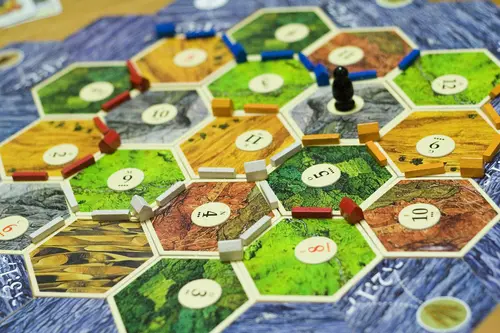
Catan (formerly known as "The Settlers of Catan") is a popular board game where players compete to build settlements, cities, and roads on an island made up of hexagonal tiles. The objective is to be the first player to earn 10 victory points.
Setup
- The board is made of hexagonal tiles that represent different resources: brick, wood, wheat, sheep, and ore. There’s also a desert tile that doesn’t produce anything.
- Each tile has a number token (2–12, except 7). These numbers determine when resources are produced.
- Players place two starting settlements and roads on the board. This happens in two rounds to ensure fairness. In the first round, players place settlements and roads in clockwise order (Player 1, Player 2, Player 3, etc.). In the second round, players place settlements and roads in reverse order (Player 4, Player 3, Player 2, Player 1).
Gameplay
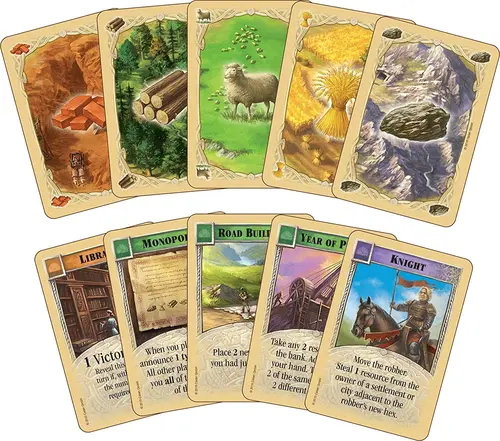
- On your turn, roll two dice. The number rolled determines which tiles produce resources. If you have a settlement or city next to that tile, you collect the corresponding resource(s). Example: If you roll a 6, and you have a settlement next to a forest (wood) tile with a 6 on it, you get 1 wood.
- You can trade resources with other players or with the bank (4:1 ratio unless you have a port).
-
Use your resources to build:
- Roads (1 brick + 1 wood).
- Settlements (1 brick + 1 wood + 1 wheat + 1 sheep). Settlement earns 1 victory point and collect resources from adjacent tiles when respective number shows up on dice roll.
- Cities (2 wheat + 3 ore). Upgrade a settlement to a city and earn an extra victory point. Collect double resources when respective number shows up on dice roll.
- Development Cards (1 wheat + 1 sheep + 1 ore): These can give you victory points, knights (to move the robber), or special abilities.
- If a 7 is rolled, the active player moves the robber to a new tile, blocking its resource production. They also steal 1 resource from a player with a settlement or city on that tile.
Special Rules
- If you build near a port, you can trade resources at a better rate (e.g., 2:1 for a specific resource).
- The player with the longest continuous road (at least 5 segments) gets 2 bonus victory points.
- The player with the most knight cards (obtained from development cards) gets 2 bonus victory points for holding the largest army.
Original, detailed game rules can be read on Catan website.
Bullshit (Bluff)

Bullshit (Bluff) is a fun and simple card game where players try to get rid of their cards by lying about what they’re playing. The goal is to catch other players in their lies or to successfully bluff your way to victory. The first player to get rid of all your cards wins the game.
Setup
- 3 or more players
- Standard 52-card deck (can add more decks for larger groups)
- Shuffle the deck and deal all the cards evenly among the players. Some players may have one more card than others, which is fine.
Gameplay
- The player with the Ace of Spades starts the game by playing it face-down in the center and declaring, “One Ace.” If no one has the Ace of Spades, the player with the lowest card (e.g., 2 of any suit) starts by playing it and declaring, “One 2.”
- Players take turns playing cards face-down in the center, following the sequence: Aces, then 2s, 3s, 4s, and so on up to Kings.
- On your turn, you must play the number of cards corresponding to the rank being played. For example: When it’s time for 3s, you must play one or more 3s (e.g., “One 3” or “Two 3s”). You can lie about the cards you’re playing. For example, you could say “Two 5s” but actually play a 5 and a 7.
- If any player thinks you’re lying, they can call “Bullshit!”. The cards you played are revealed: If you were telling the truth, the player who called “Bullshit” picks up the entire discard pile. If you were lying, you pick up the discard pile.
- If no one calls “Bullshit,” the cards stay face-down in the discard pile, and the next player takes their turn.
Author
Anurag Gupta is an M.S. graduate in Electrical and Computer Engineering from Cornell University. He also holds an M.Tech degree in Systems and Control Engineering and a B.Tech degree in Electrical Engineering from the Indian Institute of Technology, Bombay.
Comment
This policy contains information about your privacy. By posting, you are declaring that you understand this policy:
- Your name, rating, website address, town, country, state and comment will be publicly displayed if entered.
- Aside from the data entered into these form fields, other stored data about your comment will include:
- Your IP address (not displayed)
- The time/date of your submission (displayed)
- Your email address will not be shared. It is collected for only two reasons:
- Administrative purposes, should a need to contact you arise.
- To inform you of new comments, should you subscribe to receive notifications.
- A cookie may be set on your computer. This is used to remember your inputs. It will expire by itself.
This policy is subject to change at any time and without notice.
These terms and conditions contain rules about posting comments. By submitting a comment, you are declaring that you agree with these rules:
- Although the administrator will attempt to moderate comments, it is impossible for every comment to have been moderated at any given time.
- You acknowledge that all comments express the views and opinions of the original author and not those of the administrator.
- You agree not to post any material which is knowingly false, obscene, hateful, threatening, harassing or invasive of a person's privacy.
- The administrator has the right to edit, move or remove any comment for any reason and without notice.
Failure to comply with these rules may result in being banned from submitting further comments.
These terms and conditions are subject to change at any time and without notice.
Similar content






Past Comments