Mosquito gets Smashed by Two Trains: A Simple Puzzle to Demonstrate Overthinking
Description of the puzzle
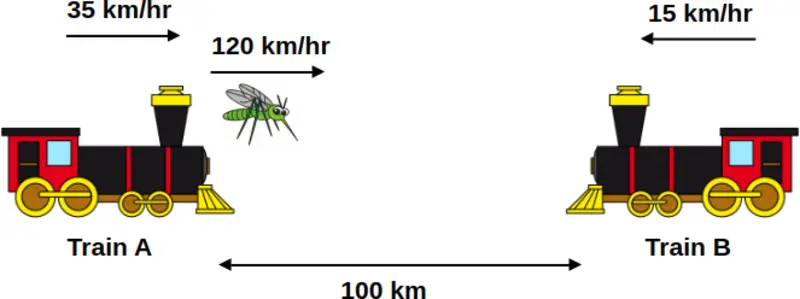
Suppose two trains, A and B, initially \(100 km\) apart are facing each other (). Train A, on the left, is moving right with the speed of \(35 km/hr\). Whereas train B, on the right, is moving left with the speed of \(15 km/hr\). Imagine a mosquito with initial position at the front of train A flying right at the speed of \(120 km/hr\). After some time, the mosquito reaches the front of train B and collides with it. When the mosquito collides with the train B, it reverses its direction and flies towards the train A with the same speed of \(120 km/hr\). The mosquito keeps flying at \(120 km/hr\), changing its direction after every collision. The process stops when the two trains collide and smash the mosquito.

shows the dynamics of the mosquito-train puzzle.
Question on the mosquito-train puzzle
Can you calculate the distance traveled by the mosquito before getting smashed by the two trains?
Solution of the mosquito-train puzzle
If you are familiar with series and convergence, you would be inclined to deriving the distance travelled by the mosquito between \(n\) and \(n+1\) collision. This would be followed by summation and calculating the limit for \(n\rightarrow\infty\). This is the pitfall that our mind directs us to take given the similarity of problem with series and convergence. I would encourage you to go ahead and derive the expressions just to understand how ugly it gets very quickly.
It turns out that we do not have to go through such complex calculation. The answer can be calculated mentally without needing a pen and paper. If you want to give it another try, now's a good time to pause.
The calculation proceeds as follows. The speed of mosquito is constant until it gets smashed by the two trains and dies. Now, how much does it take for the trains to hit each other? It is \(\frac{100}{35+15}=2 hr\). This implies that the distance travelled by the mosquito is equal to \(120\times 2=240 km\). Q.E.D.
Author
Anurag Gupta is an M.S. graduate in Electrical and Computer Engineering from Cornell University. He also holds an M.Tech degree in Systems and Control Engineering and a B.Tech degree in Electrical Engineering from the Indian Institute of Technology, Bombay.
Comment
This policy contains information about your privacy. By posting, you are declaring that you understand this policy:
- Your name, rating, website address, town, country, state and comment will be publicly displayed if entered.
- Aside from the data entered into these form fields, other stored data about your comment will include:
- Your IP address (not displayed)
- The time/date of your submission (displayed)
- Your email address will not be shared. It is collected for only two reasons:
- Administrative purposes, should a need to contact you arise.
- To inform you of new comments, should you subscribe to receive notifications.
- A cookie may be set on your computer. This is used to remember your inputs. It will expire by itself.
This policy is subject to change at any time and without notice.
These terms and conditions contain rules about posting comments. By submitting a comment, you are declaring that you agree with these rules:
- Although the administrator will attempt to moderate comments, it is impossible for every comment to have been moderated at any given time.
- You acknowledge that all comments express the views and opinions of the original author and not those of the administrator.
- You agree not to post any material which is knowingly false, obscene, hateful, threatening, harassing or invasive of a person's privacy.
- The administrator has the right to edit, move or remove any comment for any reason and without notice.
Failure to comply with these rules may result in being banned from submitting further comments.
These terms and conditions are subject to change at any time and without notice.
Similar content


Past Comments