A Drunk Ant, a Drunk Man and a Drunk Bird: Random Walk in 1D, 2D and 3D

Random walk

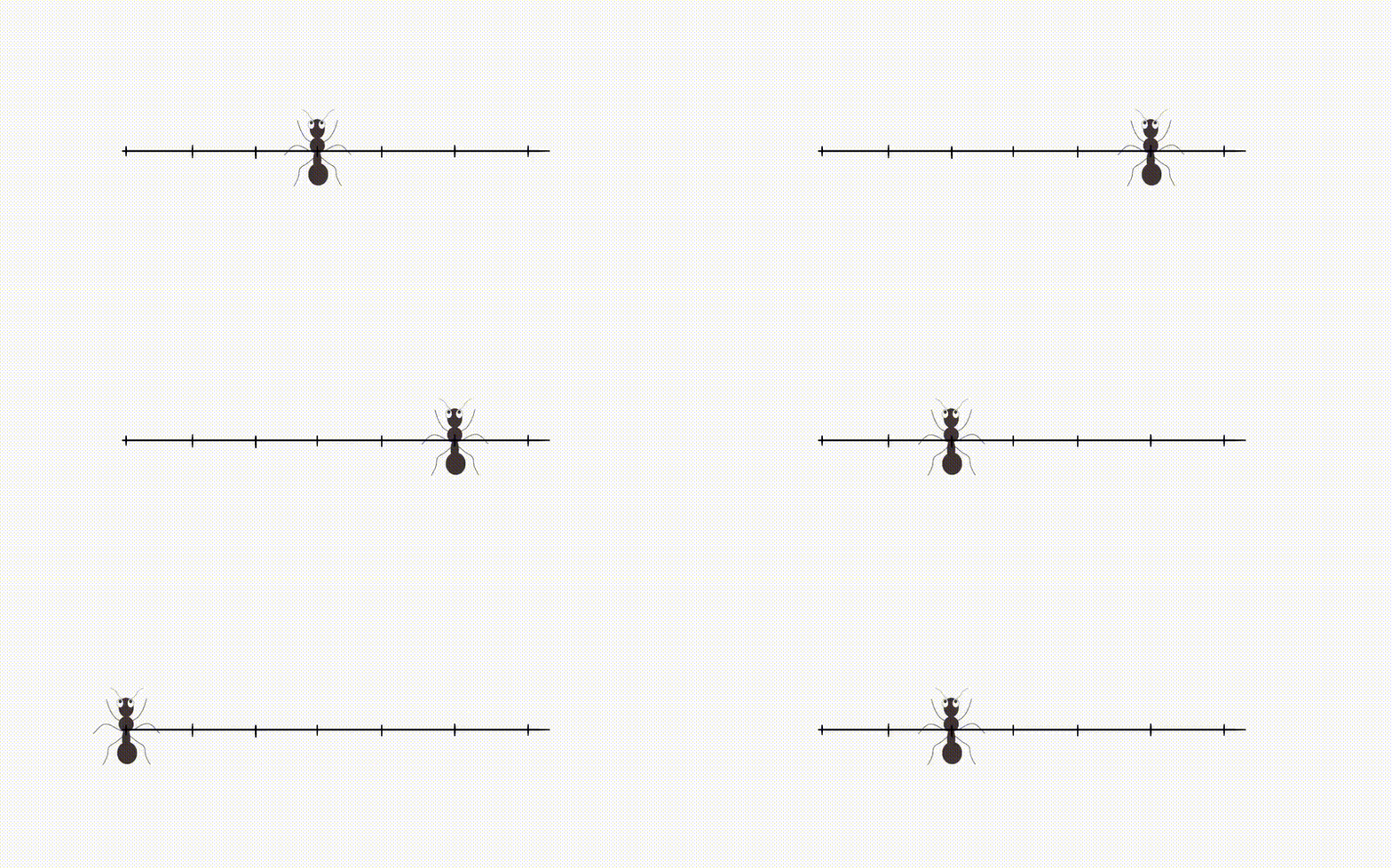
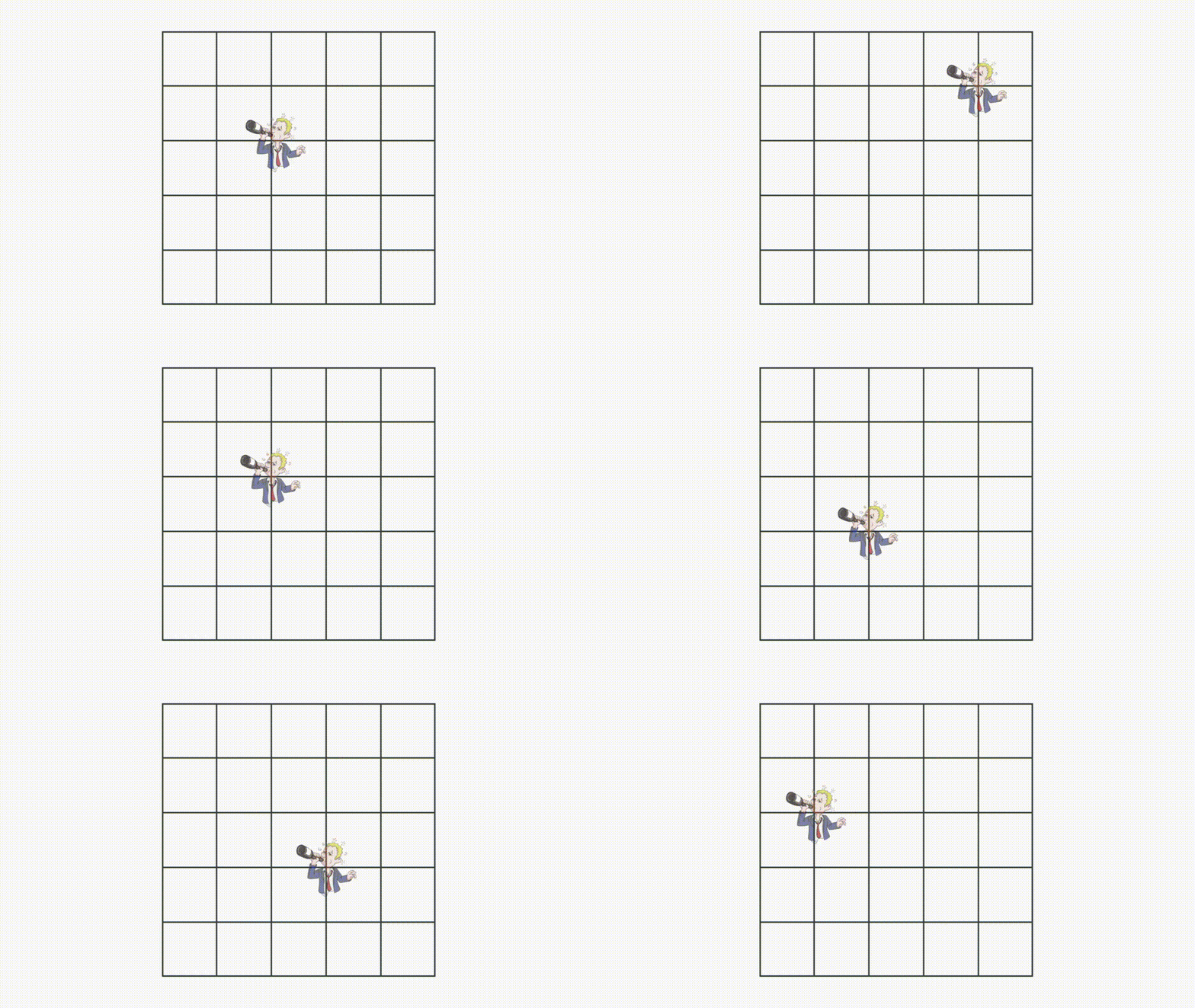
Random walk is a well-studied problem in probability and random processes. It models an entity which moves in a random direction at each time step. The random direction is chosen uniformly over all possible options. The number of options depends on the dimension of the random walk.
Aside: Brownian motion is an important example of random walk. It is used to study motion of particles in a medium. Brownian motion is also used to derive several other mathematical results. The article Eclipse attack on a blockchain network uses a test statistic for change detection that converges to Brownian motion asymptotically.
Counter-intuitive result in random walk
The focus of this article is an interesting, counter-intuitive result on random walk. Suppose, I were to ask you this question: if the entity starts from the origin, is it guaranteed that it will return to the origin sometime in the future? Our intuition would suggest that the entity should definitely return to origin, independent of the dimension of the problem. It turns out that this intuition is partially correct and cannot be generalized for all dimensions. Specifically, for random walk in 1 and 2 dimension, the entity is guaranteed to return to the origin, but not in 3 dimension random walk. In this article, we will use mathematics to analyze this result.
Analysis of random walk in 1D, 2D and 3D
In our definition of random walk, random steps were allowed only along the axis. This constraint implies that if the entity starts from the origin, it can return to the origin only after even number of steps. Using this insight, we can calculate \( P_{2n} \), the probability of returning to origin in \(2n\) steps for \(n\) in the set of positive integers. Note that \(P_{2n}\) is not the probability of first return.
For 1D, if the entity returns to the origin, it must have taken \(n\) steps in the right direction and \(n\) steps in the left direction over te. Calculating \(P_{2n}\) using permutation and combination yields,
Recurrence in Markov chain
Random walk is an example of Markov chain on a lattice. A state \(s\) in a Markov chain is transient, if, starting from state \(s\), there is a non-zero probability that it will never return to state \(s\). Otherwise, the state \(s\) is recurrent. To prove our result, we need to prove that the origin is a recurrent state.
We will present an important result from theory of Markov chain to prove that the origin is a recurrent state. The result is as follows. Let \(P_n\) denote the probability of return to the origin in \(n\) steps. Then,
Reimann Zeta function
We will need another important result from theory of series and their convergence to calculate whether \(\sum_{n=1}^{\infty}P_{2n}\) is finite or not. The result is as follows.Author
Anurag Gupta is an M.S. graduate in Electrical and Computer Engineering from Cornell University. He also holds an M.Tech degree in Systems and Control Engineering and a B.Tech degree in Electrical Engineering from the Indian Institute of Technology, Bombay.
Comment
This policy contains information about your privacy. By posting, you are declaring that you understand this policy:
- Your name, rating, website address, town, country, state and comment will be publicly displayed if entered.
- Aside from the data entered into these form fields, other stored data about your comment will include:
- Your IP address (not displayed)
- The time/date of your submission (displayed)
- Your email address will not be shared. It is collected for only two reasons:
- Administrative purposes, should a need to contact you arise.
- To inform you of new comments, should you subscribe to receive notifications.
- A cookie may be set on your computer. This is used to remember your inputs. It will expire by itself.
This policy is subject to change at any time and without notice.
These terms and conditions contain rules about posting comments. By submitting a comment, you are declaring that you agree with these rules:
- Although the administrator will attempt to moderate comments, it is impossible for every comment to have been moderated at any given time.
- You acknowledge that all comments express the views and opinions of the original author and not those of the administrator.
- You agree not to post any material which is knowingly false, obscene, hateful, threatening, harassing or invasive of a person's privacy.
- The administrator has the right to edit, move or remove any comment for any reason and without notice.
Failure to comply with these rules may result in being banned from submitting further comments.
These terms and conditions are subject to change at any time and without notice.
Similar content



Past Comments